 English
 Français

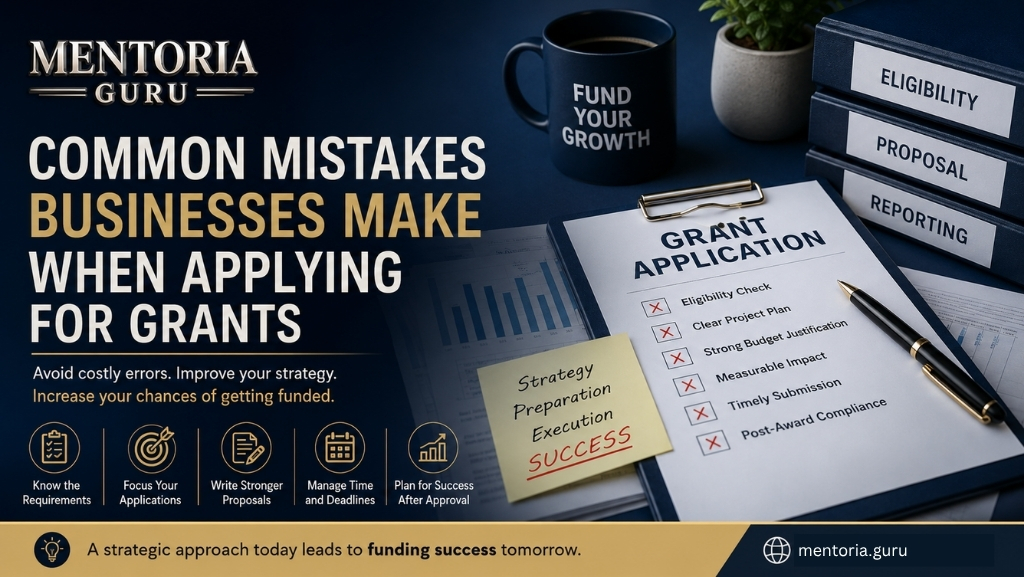
There’s a frustrating pattern that plays out across Canada every year. A business with genuine potential, a credible team, and a real need for capital submits a grant application — and hears nothing back. Or worse, receives a rejection with little explanation.
The problem, more often than not, isn’t the business. It’s the process. Grant funding in Canada is competitive, and the gap between a fundable business and a funded one almost always comes down to avoidable errors in strategy, preparation, and execution.
This guide walks through the most common grant application mistakes Canadian businesses make — and more importantly, what to do instead.
Mistake #1: Skipping the Eligibility Check
It sounds obvious, yet it remains the single most common reason for rejection. Business grant eligibility requirements in Canada vary considerably by program, and many applicants don’t read the fine print carefully enough before investing time in an application.
Eligibility filters can include business size, legal structure, industry sector, geographic location, fiscal year, employee count, and even the specific use of funds. A program designed for scalable tech ventures won’t serve a traditional services firm — no matter how compelling the narrative.
The strategic fix is simple but underused: treat eligibility screening as the first step, not an afterthought. Before you write a single word of your proposal, verify that your business genuinely qualifies. If there’s any ambiguity, contact the program officer directly. It’s a five-minute call that can save weeks of misdirected effort.
Mistake #2: Applying to Everything at Once
When founders discover how many startup funding options exist in Canada, the instinct is often to apply broadly. Submit enough applications, the thinking goes, and something will land.
This approach almost always backfires. Generic applications — the kind written to fit multiple programs with minimal customization — rarely succeed in any of them. Grant reviewers can identify a templated proposal quickly. And spreading your effort too thin means none of your applications get the attention they deserve.
The startup funding challenges in Canada are real, but volume isn’t the answer. Strategic focus is. Identify two or three programs with genuine alignment to your business model, stage, and goals. Then build targeted, well-researched applications for each one.
Mistake #3: Treating the Proposal as a Formality
A grant proposal isn’t a business plan summary. It’s a strategic document designed to demonstrate to a specific funder why your project deserves their investment. When businesses treat it as a form to fill in rather than a case to build, the results show.
The most common structural weaknesses include vague project descriptions that lack measurable outcomes, budget narratives that don’t clearly link expenses to activities, and impact statements that speak in generalities rather than specifics.
Strong grant proposal writing for startups starts with a clear understanding of what the funder values. Read the program guidelines carefully. Look at past recipients where available. Then build your narrative around the outcomes that matter most to the program — not just the outcomes that matter most to your business.
- Lead with the problem, not the solution — frame the need before the pitch
- Be specific about milestones, timelines, and measurable results
- Tie every budget line to a defined activity or deliverable
- Write for the reviewer, not for yourself — clarity beats sophistication every time
Mistake #4: Poor Timing and Deadline Management
Grants operate on cycles. Many programs have fixed intake windows — sometimes once or twice a year — and missing them means waiting months for the next opportunity. Yet a surprising number of businesses only discover a program exists a few days before the deadline.
Rushed applications are rarely competitive ones. The research takes time. The documentation takes time. Writing a proposal that genuinely reflects your business and speaks to the funder’s priorities takes time.
The solution is to build a proactive funding calendar. Map out the programs relevant to your business and note their typical intake periods. Treat grant applications like financial planning — something you schedule well in advance, not something you react to.
Mistake #5: Underestimating Post-Award Obligations
Receiving a grant is often treated as the finish line. It isn’t. Most Canadian government grants come with reporting obligations, milestone tracking, and fund usage documentation that must be managed throughout the grant period.
Failing to meet these obligations doesn’t just create administrative headaches — it can jeopardize future applications. Some programs share compliance data across agencies, and a history of poor reporting can quietly close doors you didn’t know were there.
If your business doesn’t have the internal capacity to manage grant compliance, factor that into your decision to apply. Better to pursue fewer programs and manage them well than to overextend and underdeliver.
Mistake #6: Navigating the Process Without Guidance
Grant applications demand a combination of skills that most founders don’t have in equal measure: policy literacy, financial documentation, persuasive writing, and program-specific knowledge. Attempting to manage all of this alone, especially for high-value programs, is one of the most common reasons strong applications fall short.
This is where working with experienced advisors makes a measurable difference. The best grant consulting for startups in Canada isn’t about outsourcing the work — it’s about bringing in the strategic perspective and program knowledge that most businesses simply don’t have in-house.
Full-service grant consulting companies in Canada provide more than application support. They help you assess your funding readiness, identify the programs most likely to align with your business, and build a proposal strategy that reflects both your goals and the funder’s priorities.
For businesses in the National Capital Region, access to advisors who offer the best grant financing consulting services in Ottawa adds a further advantage — local program knowledge combined with a national funding perspective.
A Practical Example: Two Rejections, Then a Different Approach
A mid-sized manufacturing company based in Ottawa had been attempting to access federal innovation funding for two consecutive years. Both applications were rejected. The leadership team was frustrated — they had a legitimate R&D initiative underway and believed strongly in the project’s merit.
When they engaged an advisor, the first thing reviewed wasn’t the proposal — it was the program selection. One of the applications had been submitted to a program that prioritized early-stage startups, which the company no longer was. The other had been submitted to a regional stream for which the company’s activities only marginally qualified.
With the right program identified, the proposal was rebuilt from scratch. The narrative was restructured to align with the specific outcomes the funder was mandated to support. The budget was reframed to reflect eligible activities more precisely. The third application was approved.
Nothing about the business had changed. The strategy had.
How Mentoria Helps Businesses Avoid These Pitfalls
Most grant mistakes aren’t the result of poor businesses — they’re the result of good businesses approaching the process without a clear strategy. That’s exactly where Mentoria steps in.
As a strategic advisor to founders and growth-stage companies, Mentoria guides clients through every stage of the funding process: from eligibility assessment and program selection to proposal strategy and post-award compliance planning. We help you understand the landscape, focus your efforts where they’re most likely to succeed, and present your business in the most compelling way possible.
Whether you’re navigating federal programs for the first time or refining a funding approach that hasn’t been producing results, working with the right advisory partner changes the trajectory — and the outcome.
Conclusion
Grant funding in Canada is competitive, but it’s not inaccessible. The businesses that consistently succeed aren’t necessarily the most innovative — they’re the most prepared. They screen eligibility before applying, build focused rather than scattered portfolios, write proposals that speak directly to funder priorities, and manage the process with the same discipline they bring to every other part of their business.
If any of the mistakes in this guide sound familiar, the good news is that they’re all fixable. The right strategy, applied at the right time, makes all the difference.
Ready to stop second-guessing your grant strategy? Book a consultation with Mentoria today. We’ll help you identify the right opportunities, assess where your current approach may be falling short, and build a clear path forward. Let’s turn your funding potential into funded results.
Frequently Asked Questions (FAQs)
1. What are the most common reasons grant applications get rejected in Canada?
The leading reasons are eligibility mismatches, weak or vague project narratives, and misalignment between the proposal and the funder’s stated priorities. Administrative errors — missing documents, incomplete sections, budget inconsistencies — are also frequent causes. Most rejections are avoidable with proper preparation and honest eligibility screening before applying.
2. How do I know which grant programs my business actually qualifies for?
Start with the eligibility criteria published by each program, paying close attention to industry, business size, stage of development, and geographic requirements. When in doubt, reach out to the program officer directly — most are willing to answer pre-application questions. If you’re finding the landscape difficult to navigate, an advisor can help you map your business profile to the most relevant opportunities quickly and accurately.
3. How long should a grant proposal take to write?
For most competitive federal or provincial programs, a thorough proposal takes anywhere from two to four weeks to prepare properly — longer if business documentation needs updating first. Rushing this process is one of the most reliable ways to produce a weak application. If a deadline is imminent and preparation time is limited, it’s often better to target the next intake window than to submit prematurely.
4. Can the same proposal be reused for multiple grant programs?
Not without significant customization. Each program has distinct objectives, evaluation criteria, and funding mandates. Proposals that feel generic or templated rarely score well with reviewers. The core information about your business remains consistent, but the narrative, budget framing, and outcome language should be tailored to each specific program you’re applying to.
5. Is professional grant consulting worth the investment for a startup?
For most early-stage and growth companies, yes. The best grant financing consulting services in Canada provide strategic value well beyond the application itself — helping you prioritize the right programs, avoid disqualifying mistakes, and build genuinely competitive proposals. The return on that investment, measured in secured funding and time saved, typically far exceeds the cost. The more relevant question is whether the cost of continued rejections — in time, opportunity, and confidence — is sustainable without it.